

Kathy
in Memos & Musings · 2 min read
Many investors think of REITs as income machines — dependable assets that generate dividends but rarely deliver meaningful growth.
Yet in reality, the story can be quite different.
Under the right conditions, Singapore REITs can offer both attractive dividend income and capital appreciation, particularly when market pullbacks push yields higher and valuations become more compelling.
And that is precisely the dynamic we are beginning to see today.
Income Spreads Remain Attractive
Let’s start things off with yields.
Today, as Singapore REIT prices fluctuate and sentiment remains cautious, dividend yields across REIT ETFs are quietly climbing back above 5%. For patient income investors, that is a signal worth paying attention to.
In fact, one thing dividend investors may notice in the current market environment is that yields are quietly becoming attractive again.
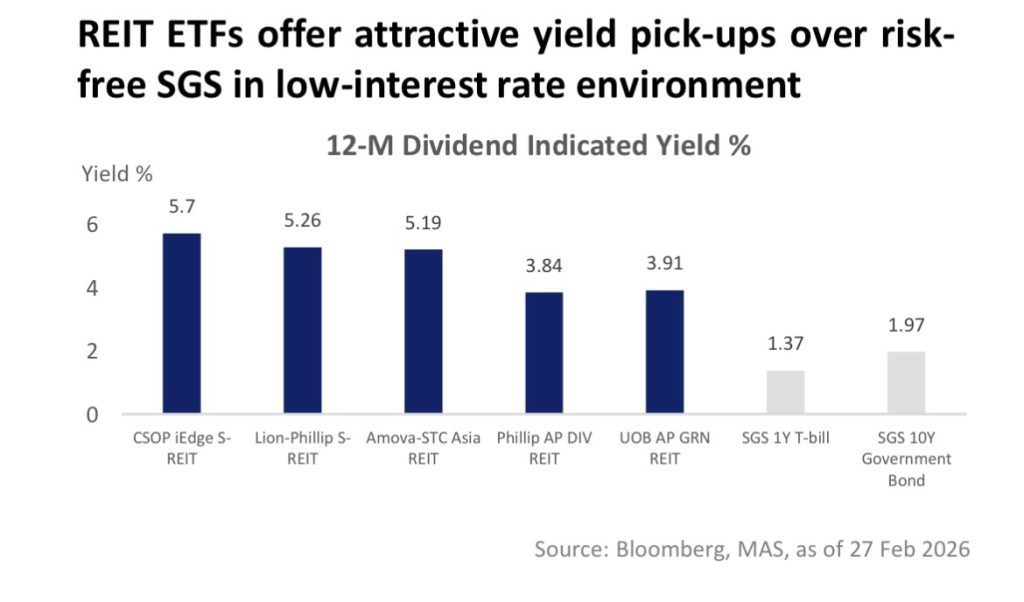
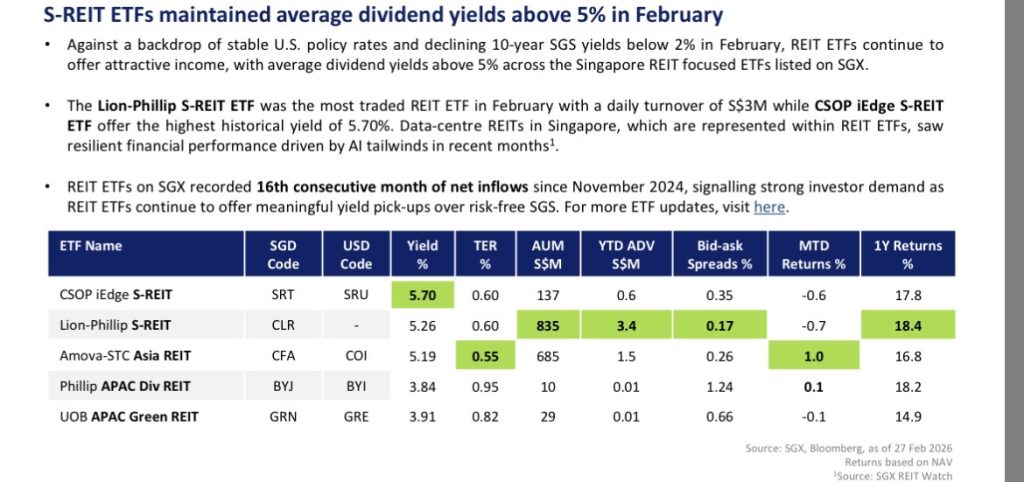
Across Singapore REIT ETFs, dividend yields remain above 5% on average, with some even approaching 5.7%.
Put that into perspective:
- 1-year Singapore T-bill: ~1.37%
- 10-year SGS bond: ~1.97%
- S-REIT ETFs: ~3.8% – 5.7%
That represents a meaningful yield pickup over risk-free government bonds.
For dividend investors, this matters because REITs are essentially income-generating assets backed by real properties. When prices pull back but distributions remain relatively stable, the result is simple: the effective yield rises.
What the Latest Data Is Telling Us
A few observations stand out from the latest data in February 2026.
- Income spreads remain attractive
Even after the rally in some REITs over the past year, income spreads over government bonds remain significant. Historically, such spreads tend to attract yield-focused investors back into the sector. - Consistent demand is showing up
S-REIT ETFs have recorded 16 consecutive months of net inflows, suggesting that both institutional and retail investors continue allocating to the sector for income. - Structural tailwinds in certain subsectors
Data centre REITs in Singapore have shown resilient performance recently, partly supported by AI-driven demand for digital infrastructure.
Income Is One Part — But Think Capital Appreciation Too
But there is another dimension to how we approach REITs investing at The Joyful Investors.
While income is an important component, part of the allocation can also be tactical from time to time.
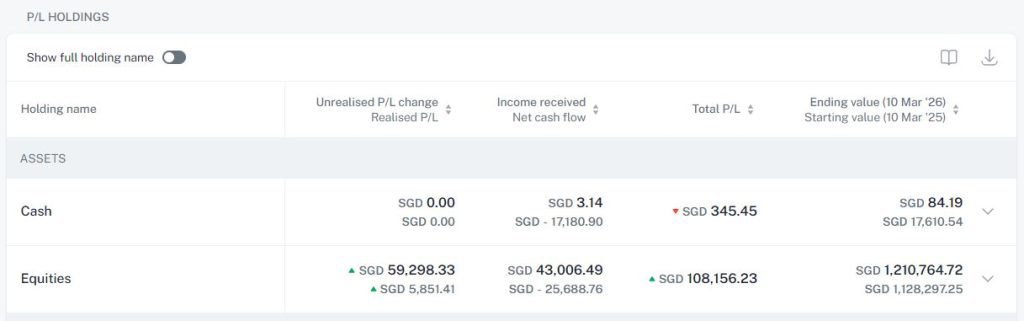
In the dividend portfolio snapshot below — which consists of both individual REITs and REIT ETFs — you may notice that about S$25,000 was withdrawn from the equities portion over the past year. That capital was initially invested into S-REITs back in April 2025 where there was a sharp selloff. It was later intentionally raised as cash and recently rotated into selected U.S. software companies where valuations became more attractive.
Source: Screengrab from one of our S-REITs Portfolios for last 1 year performance as of 11th March 2026
This approach is consistent with our Moneyball Investing Methodology, where capital is not static, but rotated toward opportunities offering a better risk-to-reward profile.
In other words, while REITs provide stable income, the broader portfolio still seeks opportunities for capital appreciation when market dislocations occur.
Interestingly, if you examine the numbers closely, you will also notice something else.
Over the past year, capital gains were roughly comparable to the dividends received, if not slightly higher.
This highlights an important point where income investing does not necessarily mean giving up on growth. When managed actively and strategically, income and capital appreciation can complement each other.
Performance Matters Most During Difficult Markets
We always love to present our portfolio performance during challenging periods like the current one, rather than highlighting results only when markets are doing well. Likewise, we also did a YouTube sharing back in October 2023 here where we covered S-REITs and what investors can think about to make better investing decisions. Every point that we shared in the video still stands today and will likely continue to do so.
We believe in not showing strong returns only when markets are rising because that’s not how money is made in the markets sustainably.
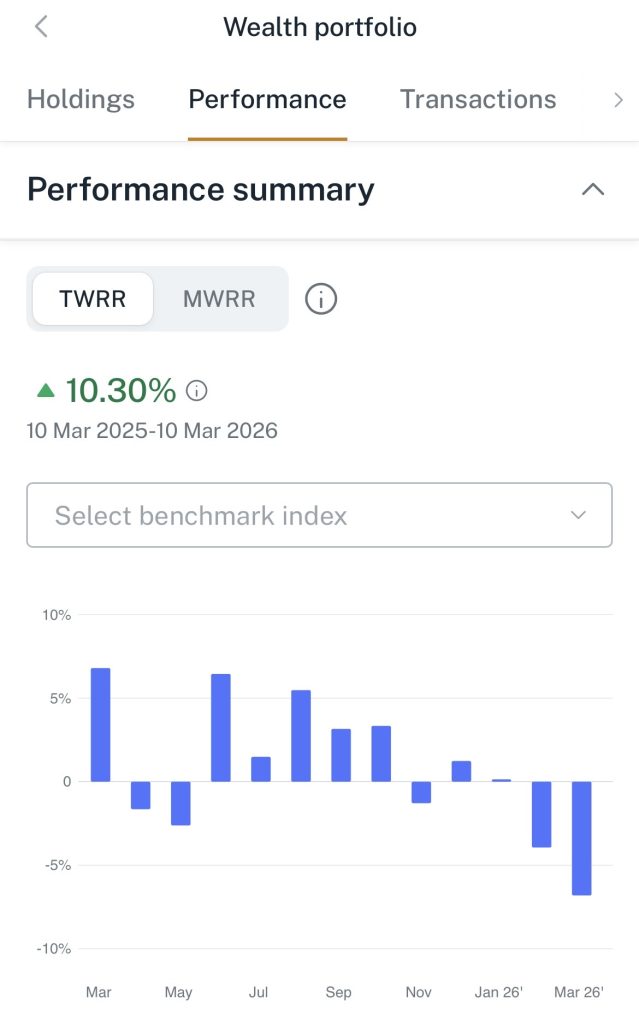
Sharing the same portfolio as what was covered in the video back in 2023, as of the past 1 year return, we have maintained respectable returns of around 10% as shown in the chart below despite suffering from one of the worst drawdowns in the last 2 months.
Source: Screengrab from one of our S-REITs Portfolios for last 1 year performance as of 11th March 2026
We always emphasize that as long as a portfolio can hold up well during more difficult environments, we usually will expect outperformance when the good times finally arrive.
So far, our track record continues to reinforce what we teach: disciplined investing, grounded fundamentals, and thoughtful capital rotation tend to win over time.
For those with a sharper eye, you may also notice that more than 80% of our REIT positions were built starting from Q4 2023, accumulated steadily over the past couple of years.
Opportunities Appear When You Are Ready
For income investors, market pullbacks can occasionally present valuable opportunities — not just in the form of higher income yields, but also potential capital appreciation. Within our investing community in TJ Academy and among our private clients in AlphaJoy, some have been quietly positioning themselves over the past few weeks. Not emotionally, but steadily.
After all, Rome wasn’t built in a day. Every sizable dividend portfolio was built the same way and compounded over time. That’s often how real income portfolios are built. Consistently and with a long-term mindset. This message was what Chief Trainer Hazelle shared with the crowd last year during SIAS AGM 2025.
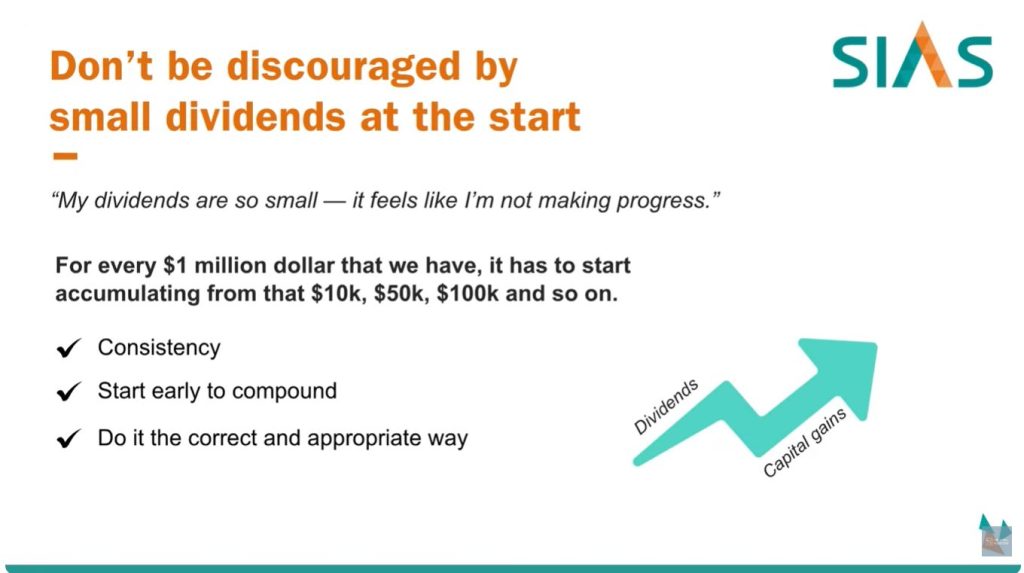
Screengrab from SIAS AGM 2025 video
To sum up, S-REITs may not necessarily be viewed purely as income instruments. But when selected carefully and combined with a disciplined portfolio strategy, they can contribute to both stable dividends and long-term capital growth.
In other words, S-REITs do not have to be just about yield.
They can also be an important building block in a portfolio that also compounds wealth steadily over time, delivering both income today and potential growth for tomorrow under the given conditions.
P.s. If you would like to learn more about how to build a S-REITs dividend portfolio that aims to generate both retirement income and long-term capital appreciation, feel free to join us at one of our upcoming workshops where we share the frameworks and strategies behind our approach.
You can learn more and register for the sessions here.
About Kathy
Co-Founder of The Joyful Investors and Co-CIO of InvestingNote Portfolio. I graduated with a degree in Economics in National University of Singapore (NUS). My previous experience with traders at the Merrill Lynch enable me to realize many counter-intuitive truths about how the financial markets work and to uncover the challenges faced by many new investors. Investing can be astoundingly simple, and my goal is to make financial education accessible and easy to understand for everyone.
Important Information
This document is for information only and does not constitute an offer or solicitation nor be construed as a recommendation to buy or sell any of the investments mentioned. Neither The Joyful Investors Pte. Ltd. (“The Joyful Investors”) nor any of its officers or employees accepts any liability whatsoever for any loss arising from any use of this publication or its contents. The views expressed are solely the opinions of the author as of the date of this document and are subject to change based on market and other conditions.
The information provided regarding any individual securities is not intended to be used to form any basis upon which an investment decision is to be made. The information contained in this document, including any data, projections and underlying assumptions are based upon certain assumptions and analysis of information available as at the date of this document and reflects prevailing conditions, all of which are accordingly subject to change at any time without notice and The Joyful Investors is under no obligation to notify you of any of these changes.
· · ·
Have you enjoyed this article? We’d be grateful if you would share this useful content to your friends who may benefit from it as well.


